



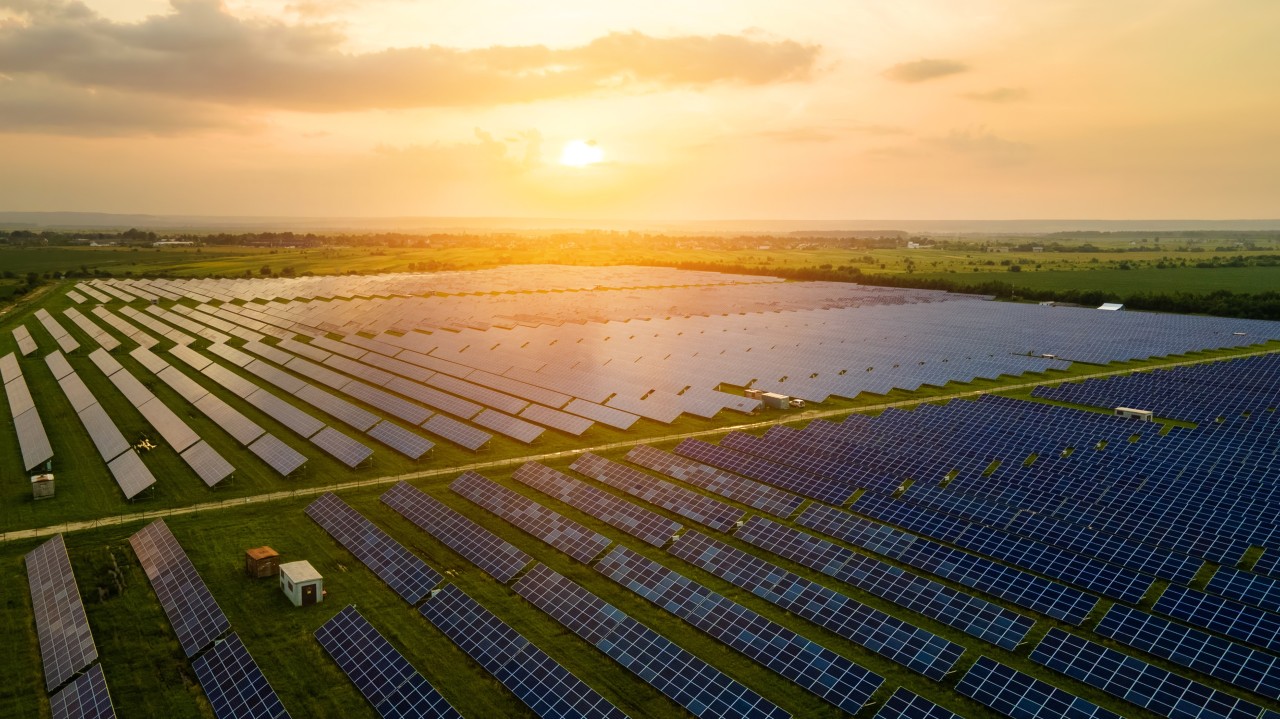
For most of the last decade, the phrase “utility-scale solar” in Europe quietly capped out somewhere in the low hundreds of megawatts. A 150 MW park made national headlines. A 300 MW project was a continental talking point. Then Romania happened.
In the space of roughly three years, three sites in Romania have redrawn the upper limit of what a single solar project can be on this continent. Rătești set the first benchmark. Ogrezeni pushed it into hybrid, storage-anchored territory. And Dama Solar is on track to become the largest photovoltaic plant in Europe, excluding Turkey. Together, they tell a story about where the center of gravity for European solar is shifting, and why so much of the smart money is pointing east.
Rătești: the project that reset the baseline
When the Rătești solar park in Argeș county, northwest of Bucharest, entered commercial operation in 2023, it became the largest operational solar plant in Romania. The numbers that felt enormous at the time now read as a starting point: 155 MW of capacity, around 170 hectares, roughly 135,000 panels, and an estimated 220 GWh of annual output, enough to cover the consumption of more than 100,000 households.
Built by Israeli developers Econergy and Nofar Energy for about 102 million euros, Rătești was the proof of concept. In October 2025, Econergy moved to take full control, agreeing to buy out Nofar’s 50 percent stake for 45.6 million euros and announcing plans to add a 120 MW battery energy storage system under a further 32 million euro investment. That last detail matters more than it first appears. The story of Romanian solar is no longer only about generation. It is about generation plus storage, working as one asset.
Ogrezeni: utility-scale becomes a hybrid system
If Rătești defined the baseline, the Ogrezeni project, also known as the Baboia Solar Plant, in Giurgiu county, redefined the architecture. Developed by Austria’s Enery and built by Romanian EPC contractor ENEVO Group, the project carries an installed capacity of 534 MW AC and 750 MW DC, for a combined photovoltaic figure of 761 MWp.
What sets it apart is the integrated battery energy storage system, rated at 534 MW with a storage capacity above 1 GWh. This is utility-scale solar designed from the ground up as a balancing asset, capable of shifting power to the hours when the grid actually needs it. Enery, which obtained its grid connection approval back in 2023, has framed batteries as standard across its Romanian portfolio rather than an optional extra. ENEVO’s leadership has described Ogrezeni as a landmark utility-scale project for national energy security, and pointed to the fact that a Romanian contractor is delivering a build of this complexity. Commissioning is targeted for the summer of 2027, under an investment estimated above 460 million euros.
Dama Solar: the new European ceiling
Then there is Dama Solar, the project that turns a regional success story into a continental headline. Located across the communes of Pilu and Grăniceri in Arad county near the Hungarian border, and developed by Rezolv Energy together with Monsson, Dama Solar spans roughly 1,064 hectares.
Its scale keeps climbing. Updated documentation lifted the proposed peak capacity to as high as 1.3 GW, with the European Bank for Reconstruction and Development referencing a figure of 1.24 GW (1,238.9 MWp DC) as it explores a loan for the project. At that size, Dama Solar surpasses Iberdrola’s 1.2 GW Fernando Pessoa project in Portugal, which has run into permitting and environmental disputes, making the Romanian site the largest planned PV plant in Europe outside Turkey. For context, Europe’s current largest operating solar farm, Witznitz in eastern Germany, sits at 650 MW of peak capacity.
The plant will connect to the 400 kV transmission network through a roughly 3.5 kilometer underground cable, and is paired with a planned 500 MW battery storage system. Rezolv won contracts for difference for 520 MW of the project at Romania’s renewable energy auction, divided the build into three units to be commissioned in sequence, and expects construction to start in mid 2026 with completion within about two and a half years, pointing to early 2029. Annual carbon dioxide savings are projected at around 619,000 tonnes, and the developer has committed to an 82 hectare on-site nature reserve, positioned as one of Southeastern Europe’s first large private-led nature restoration projects tied to a solar park.
Why these three sites landed in Romania
It would be easy to treat three giant projects as a coincidence. The evidence suggests otherwise. Several structural factors have made Romania an unusually strong fit for solar at this scale.
A credible, well-funded support mechanism. Romania’s Contracts for Difference scheme, developed with EBRD support and financed through the EU Modernisation Fund, has run two auctions that together awarded around 4.2 GW of capacity, surpassing the 3.5 GW target in the country’s Recovery and Resilience Plan. The second round alone attracted bids above 5,500 MW, with solar prices as low as 35 euros per MWh. That is genuine competitiveness, not subsidy dependence.
Bankability that lenders recognise. The presence of the EBRD, the EIB, the IFC and major commercial banks across Romanian solar and storage deals signals that these projects clear international due diligence. CfD-backed revenue stability is precisely what allows lenders to underwrite GW-scale assets.
Demand that is real and rising. Long-term corporate power purchase agreements are anchoring new capacity, and large electricity users, including data centre operators, are increasingly drawn to a market where clean power is both abundant and contractually secure. One assessment puts Romania’s solar market on a path from roughly 6.8 GW in 2025 toward more than 15 GW by 2031.
A policy direction aligned with the EU. With a national goal of renewables reaching 38.3 percent of consumption by 2030, and a dual-use framework now allowing agriculture and solar to share grassland, the regulatory environment is moving toward enabling scale rather than constraining it.
Objectivity requires naming the friction too. Grid congestion is a genuine constraint, and Romania has tightened connection rules, including financial guarantees and a move toward auctioning connection capacity. Some large projects have stalled or been cancelled over legal and permitting uncertainty, and Dama Solar itself has faced environmental complaints during development. The market is shifting from a phase of pipeline inflation toward one of discipline, where the projects that win are the ones where land, permits, grid access, financing and offtake all line up. The encouraging signal is that Rătești, Ogrezeni and Dama Solar are largely clearing those bars rather than tripping over them.
Momentum Energy’s View
What strikes us most is not any single megawatt figure. It is the trajectory. In under three years, Romania moved from celebrating its first 155 MW park to hosting Europe’s largest planned PV plant, and it did so while making battery storage the default rather than the exception. That combination, large generation tightly coupled with large storage, is the version of “utility-scale” that the rest of Europe will increasingly have to match.
We read these three sites as a single signal. A country becomes a serious destination for energy capital when policy, financing and demand reinforce one another, and Romania has reached that point. The CfD framework gives revenue certainty, international lenders are validating the risk, and corporate and industrial buyers are competing for the output. For developers, investors and offtakers weighing where to commit in Central and Southeastern Europe, the case for Romania is no longer aspirational. It is being poured in concrete, one gigawatt-class project at a time.
The honest caveat is execution. Grid reinforcement, permitting clarity and community trust will decide how many of the next Dama-sized projects actually reach commercial operation. But if the question is where the new European definition of utility-scale is being written, the answer, for now, is being written in Romanian.
