


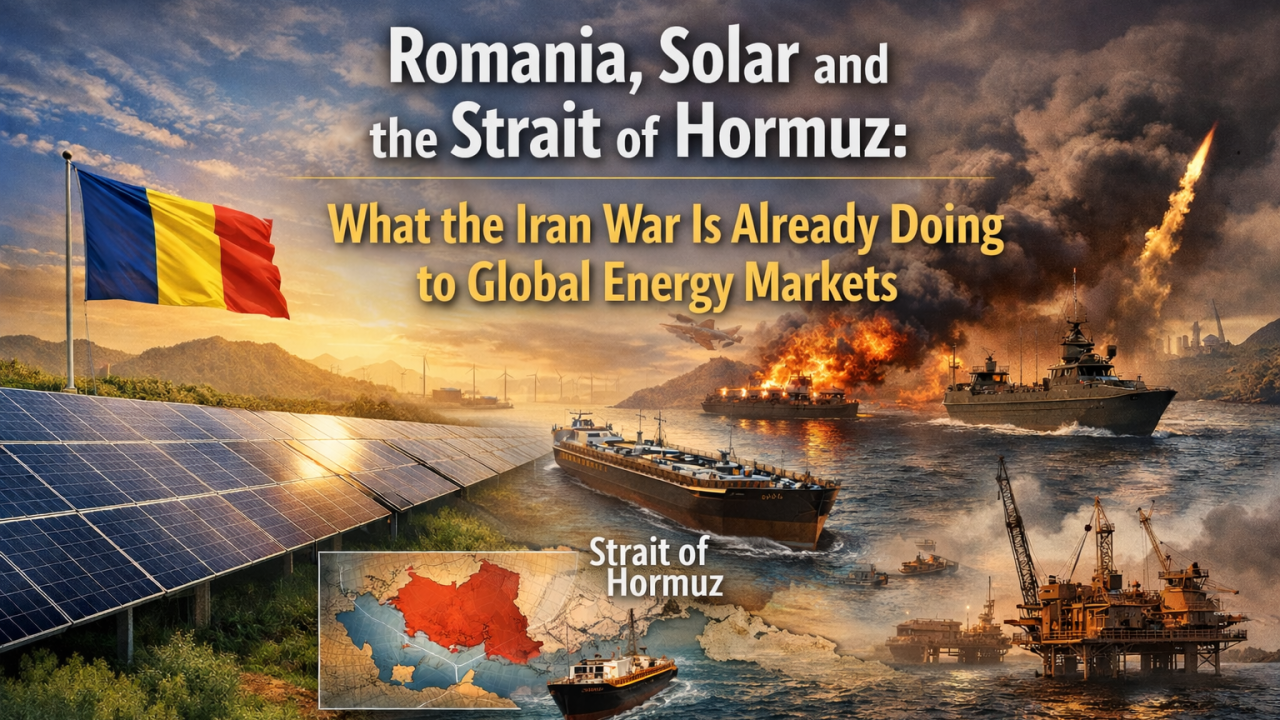
For Romania, the war involving Iran and the severe disruption around the Strait of Hormuz are not distant geopolitical events. They are already visible in the energy system Europe buys from every day: oil prices have jumped, gas markets have tightened, shipping risks have risen sharply, and policymakers are moving to protect supply. In that environment, Romania’s growing solar base looks less like a long-term climate story and more like a current energy-security asset.
What is happening now
The conflict that began on 28 February 2026 has materially disrupted oil flows through Hormuz. The IEA said export volumes of crude and refined products are now below 10% of pre-conflict levels, and member countries approved a 400 million barrel emergency stock release the largest coordinated release in the agency’s history.
At the same time, official messaging from Tehran has been mixed. On 12 March 2026, Iran’s new supreme leader said the Strait of Hormuz should remain shut, while Iran’s U.N. ambassador said Tehran was not going to close it. Even so, Reuters reported traffic was down sharply, tankers were anchored, and insurers described the situation as a “de facto close” driven by threat perception and attacks on vessels.
The market response has been immediate:
- Brent crude hit $119.50 per barrel this week before easing back, but remained elevated on 12 March.
- Europe’s benchmark gas price has risen nearly 50% since the conflict tightened LNG supply.
- The IEA has described this as the largest oil-supply disruption in history.
Why Hormuz matters so much
The Strait of Hormuz is not just another route on the map. It remains one of the most critical energy chokepoints in the world.
- In 2025, about 20 million barrels per day of crude oil and oil products moved through the Strait roughly 25% of global seaborne oil trade.
- More than 112 bcm of LNG also transited Hormuz in 2025, equal to almost 20% of global LNG trade.
- Oil has only limited bypass options: the IEA estimates just 3.5 to 5.5 mb/d of alternative pipeline capacity. For LNG from Qatar and the UAE, the IEA says there are effectively no alternative export routes to the global market.
That is why even partial disruption in Hormuz quickly becomes a global pricing event. The issue is not only physical supply; it is also freight, insurance, rerouting and the loss of flexibility across the whole system.
What Europe is already seeing
Europe is not the biggest direct buyer of LNG moving through Hormuz, but it is still highly exposed through price formation and storage needs.
- Reuters reports Europe needs around 700 LNG cargoes, or 67 bcm, to refill storage this summer about 180 cargoes more than last year.
- European gas storage is expected to end March only 22% to 27% full, versus a five-year average of about 41%.
- The European Commission is already preparing to soften gas authorisation rules to avoid delays to shipments at a moment of vulnerability.
This is the important point for industry: Europe’s energy system still transmits imported-fuel shocks very quickly. Even when the disruption happens far from the EU, its effects show up in gas, power, logistics and hedging costs across the region.
Why this matters specifically for Romania
Romania is part of that European market, so it is not insulated from global fuel-price shocks. But it is also entering this period with a stronger domestic solar platform than it had even one year ago.
- Romania added 2.2 GW of solar in 2025, taking total installed capacity past 7 GW.
- The country’s first two CfD auctions awarded 4.2 GW of renewable capacity in total, above the national target of 3.5 GW.
- In the second auction, solar PV bids were reported as low as €35/MWh, underlining the competitiveness of new solar capacity in Romania.
- The European Commission has also approved a €150 million Romanian support scheme for electricity storage, aimed at adding at least 2,174 MWh of new storage capacity.
Eurostat’s latest 2026 energy publication also shows that natural gas accounted for 36% of Romania’s domestic energy production in 2024, while crude oil accounted for 13%. That matters because Romania’s energy mix is still linked to hydrocarbons, but it also shows the importance of expanding domestic electricity sources that are not tied to global fuel shipping routes.
Why solar looks more strategic in this market
This is where the technical case becomes clearer.
Once a solar asset is installed, its generation does not depend on imported fuel cargoes, marine insurance or maritime chokepoints. That does not make solar “risk-free” projects still depend on grid access, balancing, storage and capital discipline but it does reduce direct exposure to the type of fuel-market shock the world is experiencing right now. That is a structural advantage, not a slogan.
The wider European trend supports that conclusion:
- Wind and solar generated 30% of EU electricity in 2025, overtaking fossil fuels at 29% for the first time.
- Reuters also reports EU battery deployment rose 45% in 2025 to 27.1 GWh, showing that the market is already building the flexibility needed to integrate more renewable electricity.
For Romania, the strategic message is straightforward: in a market being destabilised by imported-fuel risk, more domestic solar generation combined with storage and grid upgrades means more price stability, more resilience and less sensitivity to events in distant chokepoints. That is not hypothetical; it is exactly the lesson current market conditions are reinforcing.
Momentum Energy’s View
The current Iran war and the disruption around Hormuz are already reshaping energy markets through higher prices, lower shipping confidence and tighter gas balances. For Europe, the episode is another reminder that energy security is not only about access to fuel it is also about how much of your power system depends on volatile imported flows in the first place. For Romania, that makes solar more than a decarbonisation technology. In the current market, it is also a strategic hedge.
