


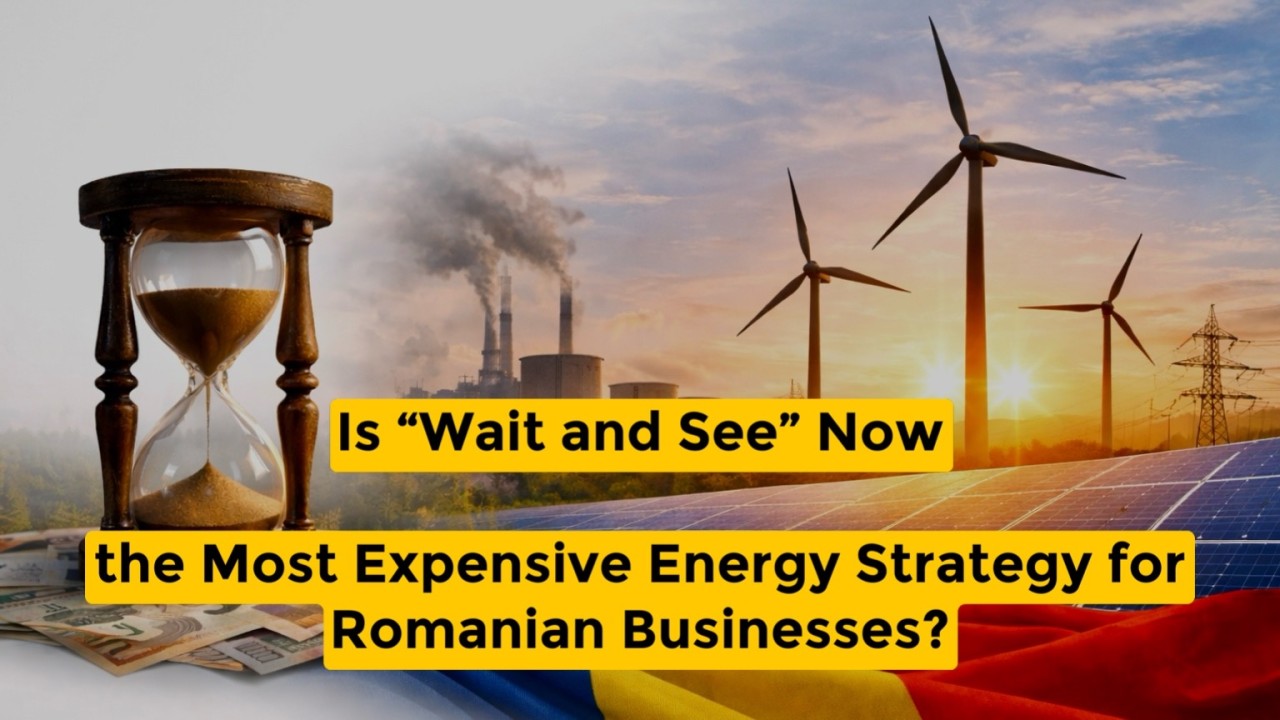
For a while, “wait and see” was a defensible energy strategy in Romania.
When markets were distorted by crisis measures, intervention was frequent, and visibility was limited, many businesses chose caution over commitment. Holding off on long-term procurement decisions felt sensible.
In 2026, that logic looks a lot weaker.
Why the cost of waiting has changed
Romania’s support measures bought companies time, but they did not remove structural risk.
Electricity price caps for households and businesses only ran through the end of June 2025, while gas caps were extended to 31 March 2026. Once electricity market liberalisation took effect, the impact was felt quickly and visibly across the economy. That alone was a reminder that energy-policy transitions do not stay on paper for long. They move into real operating costs, real inflation, and real pressure on margins.
That changes the meaning of inaction.
Waiting is not neutral. It means staying exposed to policy shifts, repricing, and short-term market volatility at exactly the moment those risks are becoming harder to ignore.
And the market is still volatile enough to make that exposure expensive. Romania’s day-ahead electricity prices remained elevated through 2025, while forward prices for 2026 showed that certainty is available — but only for businesses willing to secure it.
That is the real turning point.
The question is no longer, “Will the market calm down on its own?”
It is, “How much is unmanaged exposure already costing us?”
Why Romania is becoming harder to ignore
What makes Romania especially interesting right now is that the country is not only experiencing volatility. It is also building more tools to manage it.
Across Europe, the direction is already clear: long-term contracts, power purchase agreements, grid investment, flexibility, and faster renewable integration are increasingly seen as the way to reduce industrial exposure to price shocks.
Romania is moving in that direction with growing credibility.
The country’s renewable Contracts for Difference auctions have already awarded more capacity than originally targeted, creating a stronger investment framework for future generation. That matters because more investable renewable supply does not just benefit developers. It also expands the medium-term options available to industrial buyers, suppliers, and energy-intensive businesses looking for greater predictability.
At the same time, Romania is beginning to strengthen the other half of the equation: flexibility.
New support for electricity storage is an important signal. Renewable growth without storage can simply shift volatility around the system. Renewable growth with storage starts to reduce it. That makes the overall market more bankable, more adaptable, and ultimately more useful for businesses trying to control cost over time rather than simply react to it month by month.
Romania’s broader energy position also supports the case.
Compared with many European peers, the country has a relatively lower level of energy import dependency. Add to that the progress of major domestic supply projects such as Neptun Deep, and the picture becomes more compelling. This is not a promise of permanently low prices. But it is a meaningful indicator that Romania is building a more resilient domestic energy platform than many still assume.
That is where the “Romania is the right location” argument starts to gain real weight.
Not because Romania is perfect.
Not because volatility has disappeared.
And not because every company should rush into the same procurement model.
But because Romania increasingly offers something more valuable than a simplistic cheap-energy narrative: it offers a growing set of options for energy control.
The real cost of waiting
This is the part many businesses underestimate.
The cost of waiting is not only the risk of paying more later.
It is also the opportunity cost of failing to put structure in place while the market is becoming more sophisticated.
Long-term procurement, onsite generation, corporate or sleeved PPAs, smart hedging, and flexibility-linked supply strategies are no longer fringe topics in Romania. They are becoming practical tools.
And the companies already using them are sending a clear message: sophisticated buyers are no longer waiting for a “perfect” market before acting.
That matters because the premium in this market is no longer just on buying energy cheaply.
It is on managing energy intelligently.
Businesses that remain fully exposed to spot-driven or short-term decision-making are still taking a position. They are simply taking it without building an advantage.
By contrast, businesses that move earlier — and move strategically — are more likely to create resilience, budget visibility, and room for growth.
Why this matters for business competitiveness
Energy is no longer just a procurement line.
For many Romanian businesses, it is becoming a competitiveness variable.
It affects cost certainty. It affects investment planning. It affects pricing confidence. And for some sectors, it increasingly affects location strategy itself.
That is why the most important energy question in 2026 may not be, “Can we afford to act now?”
It may be, “Can we afford to remain exposed while others lock in smarter structures first?”
Because once the best counterparties, the strongest project-linked opportunities, and the most attractive long-term arrangements are taken, the late movers are left negotiating from a weaker position.
And that is usually when “wait and see” becomes expensive.
Momentum Energy’s View
At Momentum Energy, our view is simple: Romanian businesses should now treat energy strategy as a competitiveness decision, not just a procurement exercise.
The evidence increasingly points in one direction. Romania combines a stronger-than-average domestic energy position with a growing renewable pipeline, increasingly credible long-term contracting frameworks, and fresh momentum behind storage and system flexibility.
That does not remove risk.
But it changes the kind of risk companies face.
The bigger risk in 2026 may no longer be acting too early. It may be acting too late — after volatility has already damaged margins, after the strongest opportunities have been locked in by more proactive buyers, and after energy strategy has become a differentiator rather than just an operational necessity.
From that perspective, Romania is becoming one of the more strategically attractive locations in the region for businesses that want more control over medium-term energy risk.
So the smartest question may no longer be, “Should we wait a little longer?”
It may be, “What combination of actions gives us the best control over cost, resilience, and growth over the next three to five years?”
Because in Romania’s energy market, waiting is still a strategy.
It is just no longer the safe one.
