


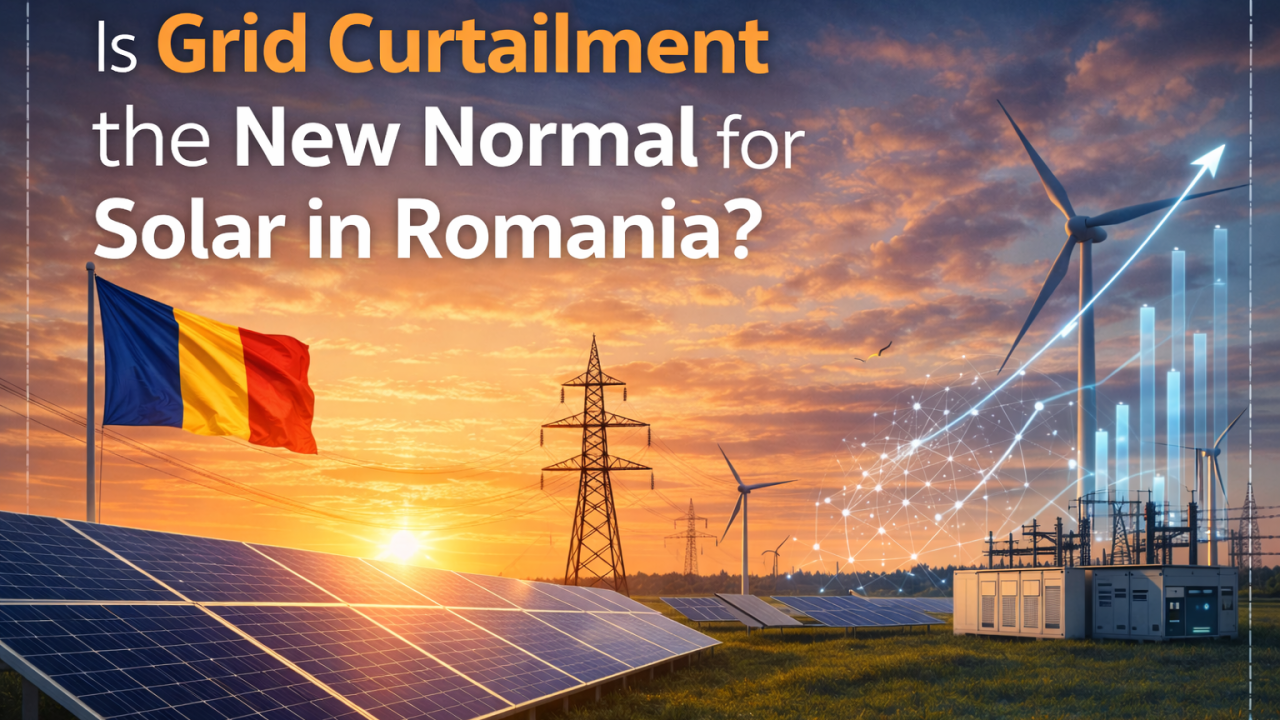
Solar energy is expanding rapidly across Europe. Costs have fallen, corporate demand has increased, and governments are pushing forward ambitious decarbonisation targets. Yet as renewable capacity accelerates, a new operational challenge is becoming more visible: not every megawatt that can be generated can always be delivered to the grid.
This phenomenon known as curtailment, when renewable generation is reduced because the grid cannot absorb all available electricity is becoming a more frequent discussion point across European power systems.
Romania’s solar sector is growing quickly, but like many emerging renewable markets, it is also beginning to face questions about grid readiness, network flexibility, and system integration. As solar capacity expands, the key issue is no longer only how much capacity can be built, but how effectively that capacity can be integrated into the power system.
So is grid curtailment becoming the new normal for solar in Romania, or is it simply a transitional challenge in a rapidly evolving market?
1) Renewable expansion is accelerating faster than grid upgrades
Romania’s renewable sector has entered a new growth phase. Solar power in particular has seen significant expansion in recent years.
According to the International Renewable Energy Agency (IRENA), Romania’s solar capacity increased substantially in 2024, with large-scale projects and distributed installations driving new additions. This reflects a broader European trend where falling technology costs and stronger policy support are accelerating solar deployment.
At the same time, grid infrastructure upgrades tend to move more slowly than renewable development cycles. Transmission and distribution networks require long permitting processes, complex engineering studies, and substantial capital investment.
This creates a structural tension:
- solar projects can be built relatively quickly
- grid reinforcement takes years to plan and deliver
As a result, power systems in many countries are encountering periods where renewable production exceeds the available transmission or system flexibility.
2) Curtailment is becoming a European-wide issue
Romania is not alone in facing curtailment risks. Across Europe, renewable curtailment has become an increasingly visible system management tool.
The International Energy Agency reported that curtailment of renewable electricity exceeded 10 TWh in the European Union in 2024, reflecting growing congestion in certain networks and periods of oversupply. These situations occur when high renewable output coincides with low demand or limited grid capacity.
Curtailment can arise for several reasons:
- grid congestion between generation and consumption areas
- limited cross-border transmission capacity
- insufficient storage or flexibility resources
- system balancing requirements during periods of high renewable output
As renewable penetration increases, these challenges become more operational than technological.
3) Romania’s solar pipeline is expanding quickly
Romania’s solar pipeline has grown significantly as investors return to the market.
The country is targeting several gigawatts of new renewable capacity under its Contracts for Difference (CfD) support scheme, which aims to deploy approximately 5 GW of solar and wind projects through competitive auctions in the coming years.
Solar development has also been supported by:
- EU recovery and resilience funding
- private investment in utility-scale projects
- rapid growth in commercial and industrial rooftop systems
According to market analyses, Romania’s renewable capacity could expand strongly by the end of the decade as new solar projects enter construction and operation.
However, rapid project growth increases pressure on grid infrastructure, particularly in regions where multiple projects seek connection to the same substations.
4) Grid congestion and connection queues are becoming critical
For developers, the most immediate challenge is often grid connection availability.
Solar projects require a technical grid connection permit known in Romania as the ATR (Aviz Tehnic de Racordare) before they can proceed toward construction and financing. As renewable development accelerates, securing these permits has become more competitive.
Several factors contribute to congestion risks:
- limited capacity at existing substations
- reinforcement requirements identified during grid studies
- clustering of projects in high-resource regions
- long lead times for transformers and network equipment
In some cases, projects that appear technically viable may still face delays or output restrictions if grid upgrades are required.
These constraints can lead to curtailment during periods when generation exceeds what the network can safely transmit.
5) Solar integration increasingly depends on flexibility
As solar penetration increases, integrating renewable energy effectively requires more than simply adding generation capacity.
Successful integration typically involves several complementary measures:
Battery storage Energy storage can shift solar generation from midday peaks to evening demand periods.
Hybrid project design Combining solar with storage or other technologies can reduce grid stress.
Stronger transmission networks New transmission lines help move electricity from generation regions to consumption centres.
Flexible market design Electricity markets that reward flexibility help balance supply and demand.
Without these measures, even cost-competitive solar projects may face operational limitations during periods of high generation.
6) Curtailment is not necessarily a failure of solar
It is important to understand that curtailment is not unique to solar energy, nor is it necessarily a sign of poor system design.
In many cases, curtailment acts as a temporary balancing tool while grids adapt to higher levels of renewable penetration.
As power systems transition away from fossil fuels, the operational focus shifts toward:
- improving grid flexibility
- strengthening transmission networks
- deploying storage
- optimizing market signals for generation and demand
These adjustments take time. During that transition, some level of curtailment can be expected in many renewable-heavy systems.
Romania: a solar market entering its integration phase
Romania’s solar sector is moving from an early growth phase into a more operational stage.
The country has strong solar resources, increasing investor interest, and supportive policy frameworks such as the CfD scheme. At the same time, integration challenges grid readiness, connection capacity, and system flexibility are becoming more visible.
This pattern is consistent with many European markets that are scaling renewable energy quickly.
The key shift is that project success increasingly depends on integration quality, not just project economics.
Developers who understand grid constraints early, plan connection strategies carefully, and consider hybrid or storage solutions are likely to be better positioned as the market evolves.
Momentum Group’s View
At Momentum Group, we see curtailment not as a signal that solar growth is slowing, but as a sign that renewable deployment is reaching a new phase of maturity.
When solar penetration rises, the competitive advantage shifts from simply developing projects to designing projects that integrate smoothly into the power system.
For Romania, the fundamentals remain strong: investor interest is increasing, policy support is improving, and the solar pipeline continues to grow. However, the next stage of market development will depend heavily on grid-aware project design, stronger network investment, and the deployment of flexibility solutions such as storage.
Curtailment may appear more frequently in the short term, but it should be viewed as part of the broader process of integrating a rapidly expanding renewable energy system.
