



Numbers do not lie. But they do require context.
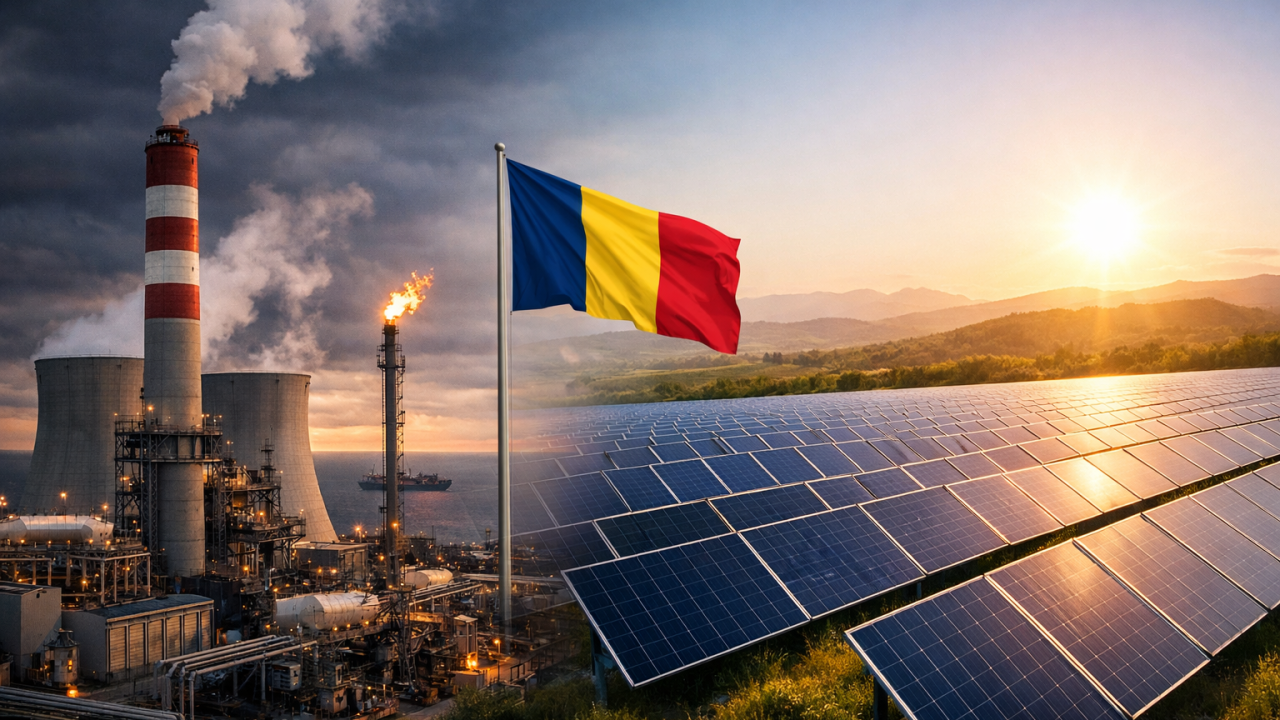
The two figures in this headline sit at the centre of what is arguably the most consequential investment calculation in Central and Eastern European energy right now. On one side: the current European gas benchmark, TTF, trading at approximately €55 to €60/MWh as the Iran conflict drives sustained price pressure across the continent. On the other: the average price at which Romanian solar projects cleared in the country’s second Contracts for Difference auction, completed in August 2025.
That clearing price was €40.46/MWh. Locked in for 15 years. Backed by the EU. Immune to Qatari drone strikes, Strait of Hormuz closures, and whatever the next geopolitical shock happens to be.
For investors evaluating where to deploy capital in European renewables, this comparison is worth sitting with for a moment.
Gas-fired power costs more than the fuel itself
The first thing to understand is that the TTF gas price is not the cost of gas-fired electricity. It is merely the input. By the time gas is converted to electricity through a combined-cycle gas turbine, accounting for conversion efficiency losses, carbon costs under the EU Emissions Trading System, grid fees, and operational expenses, the actual cost of generation runs substantially higher than the fuel alone.
Before the Iran conflict began on 28 February, TTF was trading at approximately €31/MWh, already double pre-crisis levels from 2021. The cost of gas-fired power in the EU was already elevated. Then, following the Iranian drone attack on Qatar’s Ras Laffan facility and the effective closure of the Strait of Hormuz, the picture changed rapidly. According to analysis from Ember published in March 2026, the cost of gas-fired power across Europe increased by more than 50% in the first ten days of the conflict alone, as TTF jumped to an average of €45/MWh in that first week. The benchmark has since risen further. Goldman Sachs has raised its Q2 2026 TTF forecast to €72/MWh. Under a scenario where Hormuz remains blocked for three months, analysts at Wood Mackenzie and Oxford Institute for Energy Studies place TTF at €90/MWh or above. A six-month blockade could push prices into the €115 to €155/MWh range.
The Romanian solar CfD floor of €40.46/MWh is now, at current gas prices, already below the cost of generating equivalent electricity from gas. Under the Goldman Q2 scenario, the gap widens to more than €30/MWh. Under the adverse scenarios, the cost advantage of locked-in solar becomes, in some markets, the difference between profitability and loss.
What Romania’s CfD actually does
The Contracts for Difference mechanism is worth explaining clearly for investors who may be encountering it for the first time.
Under the scheme, which is financed by a €3 billion EU Modernisation Fund allocation and was developed with EBRD technical assistance, project developers participate in competitive auctions to set a strike price for their electricity output. That strike price is guaranteed for 15 years from the date of commercial operation. If the market reference price falls below the strike, the state compensates the developer for the difference. If market prices rise above it, the developer returns the difference. It is a two-way mechanism designed to provide revenue certainty without creating windfall gains.
This structure is what makes Romanian solar projects bankable in the eyes of European and international lenders. The EBRD has specifically described the CfD as providing “long-term revenue stability to developers, thus strengthening the market integration for renewables.” Norway’s Scatec, which reached financial close on 190 MW of CfD-backed capacity in Romania earlier this year as part of a €121 million financing package co-funded by the EIB and EBRD, was direct about the reasoning: the CfD framework delivers the revenue visibility that project finance requires.
Reading the auction price trajectory
One of the most instructive data points in Romania’s renewable market story is not the current clearing price, but the direction it has moved.
In the first CfD auction, completed in December 2024, solar cleared at an average of approximately €51/MWh. The ceiling at that point was €91/MWh. In the second auction, completed in August 2025, solar cleared at an average of €40.46/MWh, with the lowest individual bid coming in at €35.50/MWh. The ceiling had itself been reduced to €73/MWh, yet projects were still bidding well below it. In a single auction cycle, Romanian solar costs fell by approximately 21%.
This is not just a market efficiency story. It is a signal about the nature of competition in the market. Twenty-six bids from eight companies competed for 1,472 MW of solar capacity. The second auction also saw a dramatic scaling up in project size: the largest project awarded reached 260 MW, compared to a maximum of 70.2 MW in the first round. These are credible industrial-scale commitments, not speculative bids.
There is an honest caveat here. The Energy Policy Group, a Bucharest-based think tank, has flagged that bids at the lower end of the range, between €35 and €40/MWh, may in some cases underestimate the risk from negative electricity pricing hours, which are increasing as solar penetration rises. The concern is worth taking seriously: Romania’s grid, like all grids in fast-growing solar markets, will see more hours of price suppression during peak generation periods. This is why hybrid PV and battery storage projects are increasingly the preferred configuration for bankable assets, and why the next phase of Romania’s buildout will be shaped by this dynamic. But that is a risk to be priced and managed, not a reason to dismiss the overall cost advantage.
What the gap is telling sophisticated capital
The investors who have been watching Romania closely have already processed these numbers.
Turkey’s Fiba Group committed to a 500 MW pipeline in Romania in March 2026, with 200 MW already secured. Rezolv Energy has accumulated multiple CfD contracts totalling hundreds of megawatts, including the expanded Dama Solar project now slated to become the largest PV installation ever built in Europe. OMV Petrom, PPC Renewables, Enery, and a growing list of institutional names have made substantial commitments to the market.
What each of them has calculated, in different ways, is essentially the same thing: a 15-year revenue floor at approximately €40/MWh, in a market where the reference fuel is currently trading at €56/MWh and trending upward, financed by EU institutions with minimal counterparty risk, represents a structurally attractive position. Not a speculative bet. A structured asset with predictable cash flows.
The question now being asked in investment committees across Europe and the wider region is not whether that calculation is correct. The question is how much time remains to act on it at current entry conditions, and whether the next CfD round will offer the same clarity and pricing that the first two did.
Momentum Energy’s View
At Momentum Energy, we have followed each of Romania’s CfD auctions closely, and the trajectory of the numbers confirms what the market fundamentals have long suggested. Romania is one of the few places in Europe where investors can access utility-scale solar capacity with long-term revenue certainty, institutional financing support, and a cost position that has improved auction by auction, at precisely the moment when the alternative, gas-fired generation, is becoming dramatically more expensive and structurally less predictable.
The spread between locked-in solar and current gas prices is not a temporary anomaly created by the Iran conflict. It reflects a permanent shift in the cost structure of power generation that was already underway before any missile was fired at Ras Laffan. The conflict has accelerated the timeline and sharpened the mathematics. For investors with the analytical tools to read those numbers clearly, Romania’s CfD market is worth examining with urgency rather than patience.
The €40/MWh figure is not just an auction result. It is a message from the market about where the cost of energy is heading. The investors who understand that message earliest will position themselves most effectively.
Momentum Energy advises on solar and renewable energy investments across Romania and Central and Eastern Europe. Follow our page for weekly market data and analysis.
