



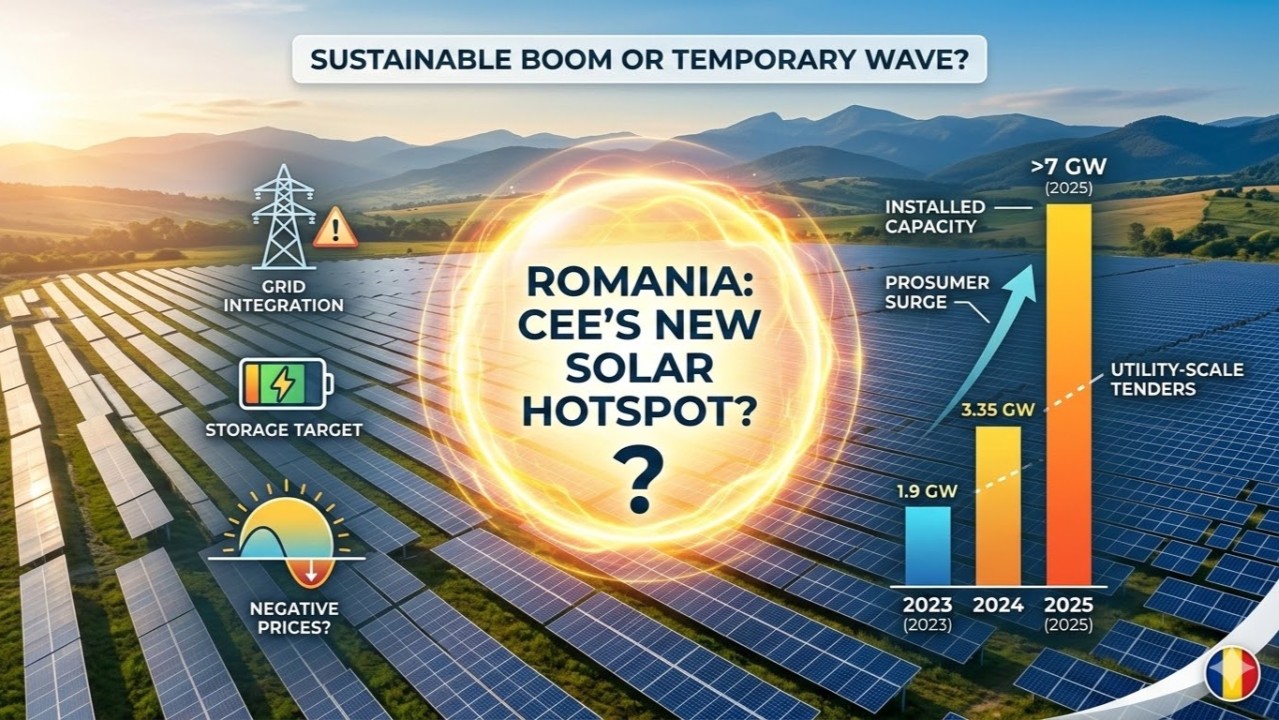
Romania is no longer a peripheral solar story in Central and Eastern Europe. Over the last two years, it has moved from being a market with visible potential to one with measurable acceleration: utility-scale tenders have advanced, prosumer capacity has surged, and cumulative solar capacity appears to have moved beyond the 7 GW mark by the end of 2025. That is a meaningful shift for a country that had only 1.9 GW of solar installed in 2023.
Still, calling Romania CEE’s new solar hotspot depends on what “hotspot” means. If it means the market with the strongest near-term momentum, Romania has a serious claim. If it means the most mature, most flexible, and least execution-risk solar market in the region, that case is harder to make. Hungary, for example, already posted one of Europe’s highest solar shares in electricity generation in 2024, showing that Romania’s rise is impressive but not yet unmatched in regional terms.
Why Romania’s solar story looks durable
The first reason is scale. Romania’s solar base expanded rapidly in 2025, with market reporting indicating around 2.2 GW of new solar added that year, pushing total installed capacity above 7 GW. That growth was not limited to one segment: utility-scale projects accelerated, while the prosumer market also became a major force, reaching almost 290,000 prosumers and 3.35 GW of installed capacity by the end of November 2025, according to ANRE data reported in early 2026.
The second reason is policy-backed bankability. Romania’s Contracts for Difference mechanism has become one of the clearest market signals in the region. The first auction launched in 2024 offered 1.5 GW of renewable capacity, including 500 MW of solar PV, and the second auction in 2025 awarded 2,751 MW of CfD-backed capacity. Together, the two rounds brought total awarded capacity to 4.2 GW, surpassing the 3.5 GW target set under Romania’s Recovery and Resilience Plan. That is not the profile of a market living on temporary enthusiasm alone; it is the profile of a market building a pipeline.
The third reason is strategic alignment with wider EU decarbonisation and security goals. Romania’s updated planning points to an energy system with 30.4 GW of renewable capacity by 2030 and 76% renewable electricity generation by the same year, while its final NECP includes an additional 3.7 GW of solar by 2030. In parallel, the European Commission has highlighted Romania’s need to diversify generation, strengthen interconnections, and integrate more renewables into the power system. In other words, solar growth in Romania is not happening in isolation; it is embedded in a broader system transition.
Why the “temporary wave” argument still exists
The bullish case is strong, but it is not risk-free. The main challenge is not whether Romania can attract solar projects. It is whether the country can integrate them efficiently.
The European Commission has been explicit that expanded interconnection capacity and greater system flexibility will be necessary to accommodate more renewable generation. SolarPower Europe has also noted that Romania’s storage target of 240 MW by 2025 is limited relative to the scale of variable renewables entering the system. This matters because a fast-growing solar market without matching grid and storage upgrades can move from undersupplied to congested surprisingly quickly.
There are already signs of that pressure. In early March 2026, Romania recorded solar production of 2,048 MW and saw negative electricity prices during peak solar hours, while prosumer and utility PV output together covered a very large share of daytime demand. That is, in one sense, a success story: solar is becoming system-relevant. But it is also a warning that generation growth is beginning to test market design, flexibility, and capture-price resilience.
There is also a policy-consistency issue. While Romania’s renewable deployment has accelerated, the European Commission has said its draft updated NECP renewable contribution of 34% by 2030 remains below the level implied by EU legislation, estimated at 41%. That does not negate Romania’s solar momentum, but it does suggest that implementation has recently moved faster than headline ambition. Investors usually prefer the reverse.
So, is Romania really becoming CEE’s new solar hotspot?
The most objective answer is: yes, but in an emerging rather than settled sense.
Romania is clearly more than a market riding a temporary wave. Temporary waves do not usually come with multi-gigawatt CfD auctions, a fast-expanding prosumer base, large-scale self-consumption support calls, and a national buildout that appears to have more than tripled solar capacity in roughly two years. Those are structural markers.
At the same time, Romania is not yet the finished article. The next phase will be less about headline megawatts and more about whether those megawatts remain investable. That means faster grid reinforcement, more storage, smarter balancing, stronger offtake structures, and continued regulatory credibility. Markets become true regional hotspots when they combine growth with repeatable execution. Romania has proven the first point. It is now being tested on the second.
A fair conclusion, then, is that Romania is not merely surfing a passing cycle. It is emerging as one of CEE’s most compelling solar markets, but it still has to convert momentum into long-term market quality. If it succeeds, the conversation will shift from “Is Romania a hotspot?” to “How far ahead can it get?”
Momentum Energy’s Perspective
From Momentum Energy’s perspective, Romania stands out not simply because of the speed of recent solar additions, but because it is entering the stage where disciplined market participants can create disproportionate value. Rapid growth has already proven the market’s attractiveness; the bigger opportunity now lies in helping projects become more resilient through stronger structuring, better integration with storage and flexibility, and a sharper focus on long-term bankability. In markets like Romania, the winners are rarely those who arrive only for the wave itself, but those who understand how to build through the volatility that follows it.
